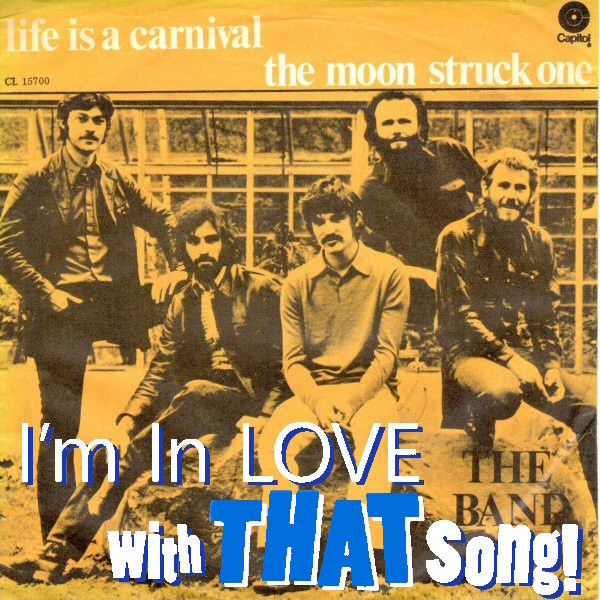
By 1971, The Band was one of the most influential forces in rock music, having steered the genre away from psychedelic excess toward a more rustic, roots-based sound. However, the recording of their fourth album, Cahoots, was a period of high tension within the group. Despite these fractures, the album’s opening track, “Life is a Carnival,” stands out as a masterpiece of groove and atmosphere, drawing on Robertson’s real-life experiences working in a traveling circus to paint a vivid picture of life as a relentless “hustle.”
Let’s dive inside the track to examine the individual elements that make it work: the interplay between Levon Helm’s “behind the beat” drumming, Rick Danko’s fretless bass, Robbie Robertson’s funky guitar work, and the “calliope” atmosphere created by Garth Hudson’s Lowrey organ. And a major highlight is Allen Toussaint’s contribution; the New Orleans legend’s horn arrangements were written specifically to weave around Robertson’s existing guitar solo, resulting in a rhythmic conversation that remains irresistible decades later. This episode is a tribute not just to a great song, but to the enduring legacy of five musicians who changed the landscape of American music.
“Life Is A Carnival” Words & Music by Robbie Robertson, Levon Helm & Rick Danko copyright 1971 WC Music Corp and Canaan Music, Inc. All rights administered by WC Music Corp
TRANSCRIPT:
Take a load off, because it’s time for another episode of the I’m in Love with That Song podcast. I’m your host, Brad Page, coming to you courtesy of the Pantheon Podcast Network, where fans belong. Each episode of this show, I pick one of my favorite songs and we take a look at it together as we try to get a better understanding of what makes a song work. We’ll dig into all those little elements, those small decisions and choices that add up to making a great song. No musical knowledge or experience is required here; we don’t get too technical. This podcast is for anyone who loves music and is curious about what makes a song great.
This time around, we’re revisiting one of the most important bands that came out of the late 1960s, and they had a huge impact on the direction of rock music. We’re talking about The Band. We’ve covered The Band once before—that was way back on Episode 17, with a song from their second album. This time, we’ll explore a song from their fourth album, released in 1971. This is a great song called “Life is a Carnival.”
(Music: “Life is a Carnival” by The Band)
In the late 1950s, a singer named Ronnie Hawkins had a backing band called The Hawks. The Hawks included four Canadians: guitarist Robbie Robertson, bassist Rick Danko, Richard Manuel and Garth Hudson both on keyboards, and one American: a drummer named Levon Helm. Hawkins built up quite a following in the Ontario area, but eventually, The Hawks outgrew working with Ronnie and split off on their own. In 1965, Bob Dylan hired them to be his band for his 1965-66 tours, and suddenly, The Hawks were thrust into the big time. They became known as simply The Band, and after working with Dylan on what became known as The Basement Tapes, they got their own record deal and released their first album, Music from Big Pink.
(Music: “The Weight” by The Band)
To say that that album was influential would be a huge understatement. It changed the landscape, the whole direction of rock music. Suddenly, the trippy excesses of psychedelic rock were out, and the rustic, return-to-roots sound that The Band exemplified became the hot new thing. But by the turn of the 1970s, the pressure of their own myth was clearly having an effect. When they recorded their first album in 1968, they were as tight as a band could get, practically telepathic in their musical communication—it was a shared communal experience. But when they headed into the studio to make their fourth album, Cahoots, in 1971, their brotherhood was being fractured by fame, substance abuse, and creative stagnation.
Probably the biggest casualty by this time was pianist and singer Richard Manuel. On their first album, he was a key ingredient of their creative stew, contributing a number of that record’s best tracks. But by the fourth album, his creative output had evaporated; he contributed no new material for this album. Drummer and singer Levon Helm’s creative input had also diminished, though he did remain their primary vocalist. That left Robbie Robertson as the driving force for getting this new album together. So then, of course, that imbalance of songwriting led to resentment from the other members. From his perspective, Robertson felt abandoned by the others and forced into taking the role of the leader. And the rest of the band, particularly Levon Helm, would become bitter about the songwriting credits and the lack of royalty payments that followed.
The studio situation just made things worse. Albert Grossman, the band’s manager and also founder of the Bearsville record label, had built Bearsville Sound Studios in Woodstock, New York. It was designed to be a state-of-the-art studio, but when The Band entered it in 1971, the studio wasn’t finished yet, and there were a lot of technical issues that just hadn’t been fixed. And the band were used to working in more natural environments. This new studio felt sterile to them—too bright, too cold. And the album that resulted, Cahoots, is often described as sounding muddy and murky.
Cahoots isn’t a concept or thematic album by design, but there is a thread that runs through the record. Maybe unintentionally, but it’s there. Most of the songs deal with obsolescence: the vanishing of trades and traditions, the extinction of animals like the buffalo and the bald eagle. You could pretty easily extrapolate these themes as representing The Band itself at this time. But we’re still talking about The Band here; even at their lowest points, they were still capable of brilliance. There are a few moments like these on the album, especially the song that opens the record, “Life is a Carnival.”
Interestingly, “Life is a Carnival” is the only song on the album where band members besides Robertson share credit. The song is credited to Rick Danko, Levon Helm, and Robbie Robertson. It features Levon Helm on drums, Rick Danko on fretless bass, Robbie Robertson on guitar, Richard Manuel on piano, and Garth Hudson on a Lowrey organ. The vocals are delivered by both Rick Danko and Levon Helm. The track opens with a single kick drum hit, then the bass, guitar, and the drums and percussion come in for four measures.
(Music: Intro to “Life is a Carnival”)
Okay, a couple of things here. First, I’m hearing a lot of noise in the left channel. I imagine you can hear it too, even on this podcast MP3 file. Now, I’m using the original CD of this album released in 2000 for this breakdown. This album was remixed and remastered in 2021, but I didn’t want to use that version because it’s significantly different than the original album, and I just wanted to stick with the original mix for better or worse. I did go back and listen to my vinyl copy of this album, and other than the typical surface noise from an old record, I didn’t really hear as much noise on the vinyl as I do on this CD. So I don’t know if this is something unique to this particular copy of the CD, but there’s definitely some distracting noise in that left channel. I could run some software to clean it up, but I’m not going to do that; I don’t want to mess with the original track. So we’ll leave it, noise and all.
Okay, so now let’s go back and listen to this intro, this time just the drums and the bass. This is quite a funky little groove that Levon and Rick are laying down. Remember that Rick is playing a fretless bass—it’s actually an Ampeg AMUB-1. We discussed these bases a little bit a few episodes ago on Episode 200 about the history of the electric bass. Let’s hear that intro.
(Music: Isolated bass and drums)
And now, let’s bring up Robbie Robertson’s guitar to see what he’s playing in counterpoint to that groove. Notice how Robbie’s guitar has a tremolo effect on it.
(Music: Isolated guitar with tremolo)
All right, now let’s put that back together and we’ll listen to the first four measures of this intro.
(Music: Reassembled intro)
And here, starting with the next measure, the horns come in. And from my money, the horns are the most exciting part of this song. They were arranged by Allen Toussaint, an absolute legend. Based in New Orleans, Allen Toussaint produced literally hundreds of recordings. He wrote a number of classic songs, he’s in the Rock and Roll Hall of Fame, the Songwriters Hall of Fame, the Blues Hall of Fame. He was awarded the National Medal of Arts by President Obama in 2013. There’s a street named after him in New Orleans; he even had his own postage stamp issued last year. His horn arrangement on this track is so great.
(Music: Intro with horn section)
A couple more things to note here: the stereo placement of the horns—some on the left, some on the right—really accentuates the way the different horns bounce off of each other in a funky conversation. Also, notice that there’s an acoustic guitar that’s been added, somewhat low in the mix, adding another percussive rhythm.
(Music: Intro with acoustic guitar detail)
That brings us to the first verse, where the vocals come in. The song is sung as a duet between Rick Danko, taking the high parts, and Levon Helm, with Richard Manuel providing backup on the choruses.
(Music: Verse 1 vocals)
That leads us into the second part of the verse and a couple of my favorite lines in the song. It’s a great example of how Robbie Robertson’s songwriting could really paint a visual picture. First, let’s bring up the vocals.
(Music: Verse 1 continued vocals)
You can really picture this guy peddling watches on the street. That’s the hustle, right? The hustle of this carnival called life. Let’s hear that verse in the final mix.
(Music: Verse 1 final mix)
And that brings us to the first chorus. Garth Hudson’s Lowrey organ is heard more prominently here.
(Music: Chorus 1)
The intro riff returns here for a few measures.
(Music: Interlude)
Here comes the second verse, which tells of a man with “a jinx in the third degree” from dealing with people “he can’t see”. This is the most enigmatic line in the song; there’s a few ways you could interpret that. One thing we should probably mention here is that Robbie Robertson actually spent time working in a carnival. When he was 14, he worked at a traveling circus and freak show outside of Toronto. I think the things he saw and experienced there were life lessons that he carried with him—a certain perspective on human nature, which I think informs this song.
(Music: Verse 2)
Before we move on, I want to go back and listen to that verse without the vocals, just to appreciate this performance. Everything about it is great. Levon Helm’s drums are played perfectly laid-back, behind the beat. He’s avoiding the typical clichés and playing around the beat. Rick Danko’s also playing bits that slide around the beat, often avoiding the ‘one’ and playing in between the beats. Robbie Robertson’s laying down an acoustic guitar track that almost functions more as a percussion instrument than a melodic one. And then there’s those horns: sharp, rhythmic stabs bouncing off of each other and the rest of the band. The playing between Rick Danko, Levon Helm, and that brass section creates this push-pull rhythm that is absolutely irresistible.
(Music: Instrumental track of Verse 2)
And the last half of this verse really gets to the crux of the song. “We’re all in the same boat ready to float off the edge of the world; the street is a sideshow, from the peddler to the corner girl. Life is a carnival, it’s in the book. Life is a carnival, take another look.”
(Music: Verse 2 conclusion and Chorus)
Next up is a guitar solo from Robbie Robertson. And what I love about this solo is the way it bobs and weaves around the other parts. But it wasn’t constructed that way; the solo was actually recorded before the brass section was arranged and recorded. Allen Toussaint received a rough mix of the song with the guitar solo already there and wrote the horn parts around the existing solo. Listen to how all of these parts—the solo, the rhythm section, and the horns—interact with each other.
(Music: Guitar solo with horn interaction)
And that brings us to a reprise of the line about the guy hawking watches before one final chorus. But before we get there, I want to listen to just the rhythm section one more time, especially to Rick Danko on fretless bass.
(Music: Rhythm section isolated)
Let’s bring the other instruments back in.
(Music: Instrumental build-up)
All right, now let’s go back, add the vocals back in, and listen to the final mix. This time, listen for Robertson’s funky guitar part and how Garth Hudson’s organ recreates the atmosphere of a circus calliope on the chorus.
(Music: Final Verse and Chorus)
And they’re going to ride out on this great groove into the fade.
(Music: Fade out)
“Life is a Carnival” by The Band.
When Cahoots was released in September 1971, it met with reviews that ranged from mediocre to downright hostile. That was something The Band wasn’t used to; they’d been critical darlings up until that point. The reaction stung, so much so that it would be four years before they released another album of new material. They followed Cahoots with a live album, Rock of Ages, that featured a horn section all arranged by Allen Toussaint. And then, an album of all cover songs called Moondog Matinee. They didn’t release an album of new original songs until Northern Lights-Southern Cross in 1975. By 1978, they called it quits and celebrated with The Last Waltz. They would later reform, but without Robbie Robertson.
All the members of The Band are gone now. Richard Manuel took his own life in March 1986. After a gig in Florida, he hung himself in the hotel bathroom. He was 42 years old.
Rick Danko passed away from heart failure at his home in December 1999. He was 55.
Levon Helm survived a bout with throat cancer in the 1990s that left him unable to sing for years. Eventually, he started singing again in 2004, but it was never really the same. The cancer returned, and after years of a valiant fight, Levon Helm died in April 2012. He was 71.
Robbie Robertson died at the age of 80 in Los Angeles from prostate cancer.
And the last surviving member, Garth Hudson, died in his sleep at a nursing home in Woodstock, New York, on January 21, 2025. He was 87 years old.
The music lives on, though—that’s a cliché to say, but it’s true. They were one of the most influential groups ever, whether people realize it or not, and that music continues to inspire and influence artists upcoming today.
Thanks for checking out this edition of the I’m in Love with That Song podcast. New episodes of this show come out on the 1st and the 15th of every month, so stay tuned for more. You can catch up on or revisit any of our previous episodes on our website, lovethatsongpodcast.com. Keep up with us on Facebook—just look for the I’m in Love with That Song podcast, you’ll find us there—or send email to lovethatsongpodcast@gmail.com.
You can support the show by going to oldglory.com and buying a t-shirt or some band merch. Use our discount code “lovethatsong” to get 15% off.
And please, share the show with the other music lovers in your life—your friends, your family. Please spread the word about this podcast, because that’s what keeps us going.
On behalf of everyone here on the Pantheon Podcast Network, I thank you for listening. And remember– life is a carnival.
(Music: “Life is a Carnival” reprise)
RESOURCES & REFERENCES:
- The Band – Official Website
theband.com - The Band: A Musical History (Comprehensive Fan Site)
theband.hiof.no
– An extensive archive of the group’s history, including Ronnie Hawkins & The Hawks and their work with Bob Dylan. - The Last Waltz (Official Trailer/Info)
mgm.com/movies/the-last-waltz - The Basement Tapes (Bob Dylan & The Band)
bobdylan.com/album/the-basement-tapes/ - Cahoots (50th Anniversary Edition)
theband.lnk.to/Cahoots50
– Information on the 2021 remix and remaster mentioned in the episode. - “Life is a Carnival” – Song Breakdown & Credits
allmusic.com/song/life-is-a-carnival-mt0003052843 - Key Collaborators & Figures
- Allen Toussaint – Rock & Roll Hall of Fame
rockhall.com/inductees/allen-toussaint - Allen Toussaint Commemorative Stamp (USPS)
about.usps.com/newsroom/national-releases/2024/0119-usps-honors-allen-toussaint-with-black-heritage-stamp.htm - Albert Grossman & Bearsville Studios History
bearsvillestudio.com/history/ - Musical Instruments & Technical Gear:
- Ampeg AMUB-1 Fretless Bass
ampeg.com/history/
The specific horizontal-scroll fretless bass played by Rick Danko. - Lowrey Organs (Garth Hudson’s Signature Sound)
lowrey.com
- Ampeg AMUB-1 Fretless Bass
- Merchandise & Support:
- Old Glory – Band Merchandise
oldglory.com
Use discount code “lovethatsong” for 15% off.
- Old Glory – Band Merchandise