
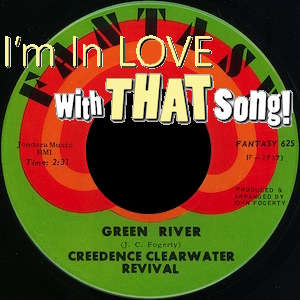
In 1969, Creedence Clearwater Revival accomplished the unthinkable: releasing three career-defining albums in a single year. At the heart of this creative explosion was “Green River,” a track that reached #2 on the charts and perfectly encapsulated the band’s “swamp rock” aesthetic. Let’s dive deep into the mastermind of John Fogerty, revealing how he his Rickenbacker and a solid-state Kustom amp to create the raw guitar tone that created an indelible riff. We also look at the locked-in rhythm section of Stu Cook and Doug Clifford and the driving force that Fogerty famously dubbed “chooglin’.”
Beyond the music, this episode uncovers the nostalgic and sociopolitical layers of the lyrics. While the song evokes the bayous of Louisiana, its true origins lie in Fogerty’s childhood memories of Putah Creek in California… and a lime-flavored soda pop. We’ll look at how the smoldering world of 1969—marked by the Vietnam War and recent political assassinations—crept into Fogerty’s writing, transforming a childhood reminiscence into a plea for a simpler time. Whether you are a recording nerd interested in the studio minutia, or a casual fan of great rock, this episode offers a comprehensive look at a timeless American masterpiece.
Words & Music by John Fogerty Copyright 1969 Jondora Music
TRANSCRIPT:
Come on home to the “I’m in Love With That Song” podcast, one of the Pantheon family of podcasts. My name is Brad Page and on each edition of this show, I pick one of my favorite songs and we explore it together, listening for all those special elements, those magic moments that make it a great song. We don’t get into music theory on this show; we focus on the arrangements, the performances, and the production that make the song work. So, you don’t need to be a musician to enjoy this show; this is a podcast for every music fan.
As we’ve done in our last couple of episodes, we’re revisiting a band that we featured on this show once before. It’s been about four years since we discussed Creedence Clearwater Revival—I can’t believe it was that long ago, actually. So, let’s return to this classic American band and explore how a group from San Francisco was able to capture the swamp rock atmosphere of the American Deep South. This is one of my favorite Creedence Clearwater Revival tracks; this is “Green River”.
[Audio Clip: “Green River”]
Back on that previous episode where we explored “Run Through the Jungle”—and if you haven’t heard that episode, go back and listen to it, it’s a good one—on that episode, we covered the early history of Creedence, so I’m not going to go over that again. We’ll pick things up in 1969. Many people consider 1969 to be the peak year for Creedence Clearwater Revival. In the span of this single year, the band released three career-defining albums: Bayou Country in January, Green River in August, and Willy and the Poor Boys in November.
John Fogerty, the mastermind behind Creedence, was always afraid that the audience would forget about the band if they weren’t inundating the airwaves with a steady stream of hit singles. “Green River” was the song that kicked off the album of the same name: side one, track one. It was released as a single in July ’69, a month before the album came out. It was written by John Fogerty and performed by Fogerty on lead guitar and lead vocal, his brother Tom Fogerty on rhythm guitar, Stu Cook on bass, and Doug Clifford on drums. It was recorded at Wally Heider Studios in San Francisco, produced by John Fogerty and engineered by Russ Gary.
The song opens with John Fogerty’s electric guitar riff. An acoustic guitar joins about halfway through before the drums and the bass kick in. Okay, first, let’s not bury the lead. Let’s take a look at Fogerty’s guitar part. It’s the crux of the song. It’s based around an E7 chord, and you don’t need to know anything about the theory behind it. Just know that the key of E, it’s the ultimate guitar key, and Fogerty works it for all its worth, hanging on this chord for extended periods. Playing in E allows him to include an open-string drone, which is often referred to as a pedal tone. That’s a term originated by pipe organ players who would use their feet to hold down low notes using pedals. But in a more general sense, it refers to a note that’s held or repeated while other notes are played over the top. In this case, Fogerty plays a pattern of notes that slowly descends while the E is sustained underneath.
[Audio Clip: Guitar Riff]
You’ll notice that that guitar is placed primarily in the right channel, and his guitar tone is pretty raw. There’s almost a brittle edge to it. I wouldn’t call it a warm tone, which is what many guitarists go for. I would chalk up that tone mostly due to the guitar amp that was used. John Fogerty preferred amps made by the Kustom company—that’s Kustom with a K—specifically, the K200A model. Kustom amps are distinctive due to their Naugahyde tuck-and-roll upholstery. But what’s important to the sound here is that these were solid-state amplifiers, not amps that use tubes, which were and still are preferred by most guitarists over solid-state amps. Tube amps have a natural compression that happens when you hit them with a loud sound; it’s a very pleasing tone. Solid-state amplifiers don’t do that. They have a much faster transient response and respond instantly with a harder, uncompressed sound. That is where the sharp, raspy tone comes from.
Now, as to which guitar Fogerty was playing, I’ve seen conflicting reports. Some sources say it’s a Gibson Les Paul Custom or a Gibson ES-175. You can find photos of Fogerty playing both of those models during this time period. But Fogerty also played a Rickenbacker 325—that’s the same model that John Lennon used to play—and I think Fogerty himself has said that that was the guitar he used here. So, I’m going to take his word for it, and that sounds right to me.
As far as the acoustic guitar, that was a Gibson J-200, which I assume was played by his brother Tom Fogerty. The acoustic is recorded a little “boomy”, not a lot of high end, and is mixed towards the left channel, so each guitar has its own space in the mix. The acoustic guitar is also just hanging on that E chord.
[Audio Clip: Guitars together]
You can also hear there’s a tambourine overdubbed there. So, after establishing the riff by playing it a few times, they launch into the first verse.
[Audio Clip: First Verse]
So, that first verse really sets the tone for where we’re going here. “Well, take me back down where the cool water flows, let me remember the things that I love.” So, it’s about a yearning for a return to a place and a time long past. And then he reminisces about some of these things: stopping at the log where the catfish bite, walking along the river road at night, and those barefoot girls dancing in the moonlight.
So, it’s a trip down memory lane, but it’s more than that. You might say it’s a longing for a more innocent time. That line about the dancing barefoot girls is interesting because it sort of speaks to an early sexual awareness, just starting to discover those feelings right before things get complicated. I think that’s a key element of this song: the desire for a life less complicated.
[Audio Clip: Verse continues]
You’ll notice the vocals have that classic slap-back echo on them, right out of the Sun Records playbook, like an old Elvis or Jerry Lee Lewis record. Another interesting note for you recording studio nerds out there: John Fogerty is singing into a Shure SM56 microphone. That was a relatively inexpensive mic; essentially, it’s a Shure SM57 but with an integrated pistol-grip stand mount. These are decent microphones for recording snare drums and guitar amps, but almost never used in the studio to record lead vocals. This mic was chosen by engineer Russ Gary, but why he chose this particular mic, I don’t really know. He said that this was the only time he ever used this mic for Fogerty’s vocal, so it was definitely an oddball choice. But it works.
With the second verse, you can imagine Fogerty reminiscing about his favorite swimming hole.
[Audio Clip: Second Verse]
There’s a nice little doubled guitar part that’s added in there. So, that verse is the first mention of Green River. There is no actual place named Green River, at least not as articulated in this song. One of Fogerty’s tendencies as a songwriter—you could call it a quirk or a stroke of genius, depending on how you look at it—but he was always evoking the sights and sounds of the South: New Orleans, the Mississippi River, the bayou. But Fogerty was a California boy, born and raised. He might have made you envision someplace in the South, but his actual childhood memory here is of Putah Creek near the town of Winters, California.
So, where did the name Green River come from? Well, Putah Creek doesn’t exactly sound as charming as Green River, and it’s not as easy to sing. So, Fogerty looked back to another childhood memory, this one of drinking one of his favorite beverages. Richard C. Jones, who owned a sweet shop, created Green River, a lime-flavored soft drink or soda pop, in Davenport, Iowa, in 1916. In 1919, he sold the formula to a Chicago brewing company who would switch to making soda during Prohibition. Eventually, other bottlers began to sell the flavor, but by the 1990s, it had all but disappeared. Though you can still buy bottles of Green River today, you’ll have to seek it out.
That verse is followed by one of those guitar and vocal moments that is so uniquely a John Fogerty signature. Then that leads us right into a short guitar solo.
[Audio Clip: Guitar Solo]
We haven’t really talked about the other guys in the band, so let’s touch on them for a moment. Doug Clifford on drums and Stu Cook on bass in particular were the engine that drives this track forward. Neither of them is playing anything complex, and neither is Tom Fogerty on rhythm guitar, but they are all locked in together. At the center of the Creedence Clearwater Revival sound is that rhythm that’s often described as “chooglin'”. Fogerty wrote a song called “Keep On Chooglin’”; he may have invented that term, I don’t know. It’s hard to describe, but you know it when you hear it, and you’ll hear it on virtually every Creedence track. Let’s hear this rhythm section “choogle.”
[Audio Clip: Isolated Rhythm Section]
And that brings us to the final verse. A little bit of a shift in lyrical tone here. Let’s listen to the vocal track first.
[Audio Clip: Isolated Vocals]
All right, let’s look at these lyrics a little closer. First, he mentions Cody’s Camp. This was an actual place, a cabin near Putah Creek that was supposedly owned by a relative of Buffalo Bill Cody. Then he sings about flat-car riders and cross-tie walkers. These are men traveling by train unlawfully—what they used to call hoboes. Here we have Fogerty as a young boy among the drifters and the outsiders. And then Old Cody Junior must be the guy who owns that cabin, takes young John aside and warns him, “You’re going to find the world is smoldering, and if you get lost, come on home to Green River.”
The shadow of the grown-up world is creeping into this childhood memory. And thinking back to 1969, when this song was released, the Vietnam War was raging, and it was only a year out from the assassinations of Martin Luther King and Robert F. Kennedy. The world was indeed smoldering. And really, looking around at our world now, when is the world ever not smoldering? But he ends the song with the plea or the reassurance that if you get lost, come on home to Green River. Now, let’s hear that final verse.
[Audio Clip: Final Verse and Outro]
Creedence Clearwater Revival, “Green River”.
“Green River” climbed the charts and reached number two. It was poised to hit number one, but it was kept out of the number one spot by “Sugar, Sugar”, a bubblegum pop song by a fake band, The Archies. Oh, the indignities! Creedence has the distinction of being the band with the most songs to reach number two without ever having a number one chart-topper. The Green River album also featured “Bad Moon Rising”, another hit that reached number two. It’s interesting to compare these two songs because while “Bad Moon Rising” juxtaposes some pretty dark lyrics with a really jaunty up-tempo beat, “Green River” sounds dark and moody even though its lyrics are more upbeat. But these are the quirks that make the music of CCR so memorable and endlessly fascinating, and it’s why these songs still stand out today.
Hope you enjoyed this episode. The “I’m in Love With That Song” podcast will return with another new episode in just about two weeks. All of our previous episodes are available on our website, lovethatsongpodcast.com, so if you missed any of them—and there are over 200 episodes now—or you just want to re-listen to an episode, you’ll find them all right there. And make sure you follow the show so that you never miss an episode.
Thanks for coming along for the ride; I really appreciate it. If you want to help the show out, the best thing you can do is to tell someone about it. Talk it up, share it with your friends and family, because recommendations from people like you are the best advertising I could ever ask for. So, thank you. I will meet you back here on the Pantheon Podcast Network for our next episode. Until then, get back down where the cool water flows, watch out for those barefoot girls dancing in the moonlight… and come on home to Green River.
RESOURCES & REFERENCES:
Bands & Artists:
- Creedence Clearwater Revival (Official): creedence-revisited.com
- John Fogerty (Official): johnfogerty.com
- The Archies (Sugar, Sugar): Wikipedia – The Archies
Studios & Production:
- Wally Heider Studios: Wally Heider Recording History
- Russ Gary (Engineer): Russ Gary Official Site
Gear & Technical:
- Kustom Amplifiers: kustom.com
- Shure SM56 Microphone: Shure SM56 Heritage
- Rickenbacker 325: Rickenbacker Official
References & History:
- Green River Soda: Green River Soda Official History
- Putah Creek (The Real Green River): Putah Creek Council
- Buffalo Bill Cody (Cody’s Camp): Buffalo Bill Center of the West
Sources & Citations:
- Levitin, This is Your Brain on Music (Sonic analysis).
- Mix Online, “Classic Tracks: Fortunate Son/Green River” (Detailed recording logs, Russ Gary interview, gear specifics).
- Wikipedia/Rolling Stone (2012 Interview, geography of the song).
- Louder Sound/Classic Rock (Historical context, album imagery).
- Louder Sound (John Fogerty interview, 1969 productivity).
GREAT ARTIST