
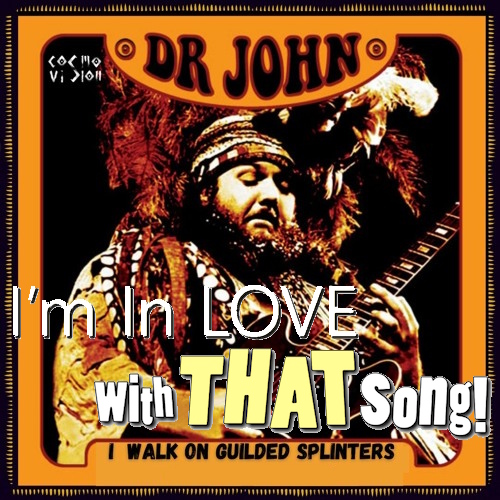
As Mardi Gras approaches, what better way to celebrate than by diving into the rich musical heritage of one of New Orleans’ favorite sons? In this week’s episode, we explore one of the city’s most iconic musicians, Dr. John, and his classic track, “I Walk on Gilded Splinters“. Released in 1968, this song is a perfect example of the unique blend of voodoo culture and psychedelic sound that characterizes Dr. John’s early work.
“I Walk on Gilded Splinters” is a mesmerizing track that runs over seven and a half minutes long, inviting listeners into a hypnotic soundscape and creates an immersive atmosphere that reflects the voodoo rituals Dr. John was inspired by. The lyrics are steeped in Creole culture, featuring references to voodoo spirits and the vibrant life of New Orleans.
So, whether you’re preparing for Mardi Gras festivities or simply curious about this spellbinding track, tune in to this episode and immerse yourself in the captivating world of Dr. John, The Night Tripper.
“I Walk On Guilded Splinters” – John Creaux [Mac Rebennack] Copyright 1967 Warner-Tamerlane Publishing Corp and Skull Music
TRANSCRIPT:
Welcome back to the “I’m In Love With That Song” podcast, part of the Pantheon family of podcasts. I’m Brad Page, your host and each episode, I dive into my record collection and come up with one of my favorite songs for us to explore here on the podcast. Don’t worry if you’re not a musician, because we don’t get deep into music theory or technical jargon here. We’re just gonna listen closely to discover what makes these songs great.
This is Mardi Gras season this year, Mardi Gras is coming up in a few days. So I thought this year, we’d celebrate by exploring one of my favorite songs by New Orleans’ favorite son, Dr. John, from his very first album back in 1968– a classic track called “I Walk On Guilded Splinters”.
Malcolm “Mac” Rebennak Jr. was born in New Orleans in November 1941. He grew up with music all around him, a musical family in a music musical city. It’s no surprise he fell in love with the local music scene. Mac initially picked up the guitar, because there were so many great piano players in New Orleans that he figured he’d have a better chance getting gigs if he was a guitar player.
He started working young. He was about 12 years old when he started playing gigs, and soon he was playing on sessions in the studio. Working with older musicians was a great learning experience, but he also picked up some pretty bad habits. By the time he was in his teens, he was using heroin.
He did a lot of session work for Cosimo Matasa, the legendary producer. And Mac was writing songs too.
On Christmas Eve 1961, Mac tried to break up a fight. But when a gun went off, Mac almost lost a finger on his left hand. Until it healed, he couldn’t really play guitar, so he switched to playing piano– the instrument he’d eventually become famous for.
Many of the New Orleans musicians Mac had been working with ended up in Los Angeles, playing on sessions with the legendary Wrecking Crew. After a short stint in Angola prison, Mac followed them to LA and started doing a lot of session work himself. He played on tons of records during this period, but frankly, he didn’t like most of the songs he was playing on. He just didn’t care much for pop music at all.
It was around this time that he came up with the character of “Dr. John”. He based his Dr. John Persona on a real-life character named Bayou John Montaigne, who supposedly taught voodoo to Marie Laveau.
So, he created this figure of “Dr. John, The Night Tripper” voodoo doctor, with a whole theatrical stage presentation, mixing voodoo ritual, stage magic, Mardi Gras spectacle, and of course, performed by authentic New Orleans musicians.
He assembled the former New Orleans musicians now living in LA, and they cut an album steeped in the sounds and rhythms of New Orleans, but with its own unique approach, bordering on psychedelic. Some of the songs were versions of old traditional numbers, others were new compositions. Some were based on actual voodoo ceremonial melodies. The album was given the name “Gris Gris”, a kind of a ritual object, a lucky charm or totem, and it was released in January 1968. It still remains one of the most mysterious, spooky records I’ve ever heard.
It was produced by Harold Batiste and performed by Dr. John on vocals, keyboards and percussion; Harold Batiste on bass and clarinet and percussion, Richard “Dr. Ditmus” Washington also on percussion; Bob West on bass, John Boudreaux on drums; Plas Johnson on saxophone; Louis Boulden on flute; Steve Mann on slide guitar and banjo; Dr. McLean on guitar and mandolin, Mo Pedido on congas and Dave Dixon, Jesse Hill, Ronnie Baron, Johnny Jones, Prince, Ella Johnson, Shirley Goodman, Sonny Race Durden and Tammy Lynn on backing vocals.
One quick note before we get started: this song at over seven and a half minutes long, is longer than most of the songs we cover on this show. And much of it is about setting a mood, creating an atmosphere. So there are some long stretches, but we’ll work our way through it. It’ll be worth it, because this is such a great track.
It begins with the bass guitar, some percussion and, quieter in the mix, an acoustic guitar played with a slide. And all of this is primarily in the left channel.
And Dr. John is going to join in with the first verse. You know it’s him right away. Even back then on his very first album, he had one of the most distinctive voices you’ll ever hear.
The song is steeped in New Orleans voodoo culture. Dr. John based it on a song he had heard sung by voodoo practitioners. And so we’ll hear a lot of voodoo terms and vocabulary, along with that Cajun French unfamiliar to many of us outside of Louisiana. Let’s hear the doctor’s vocal track.
In the lyrics, he mentions “Le Grand Zombie”, which is a reference to a powerful serpent spirit. Serpents are believed to hold unspoken knowledge, and voodoo devotees communicate with the spirit world through them. You also hear him refer to “The King of the Zulu”. King of the Zulu is the central figure in the Mardi Gras parade. And as for the song title, “Gilded Splinters”, according to some, gilded splinters are the points of a planet, related to astrology. However, Dr. John himself said that in the original song, they sung of “gilded splendors”, but he changed it to “splinters” because he just liked the sound, and the visual, of gilded splinters.
The chant like vocals of the backing singers are panned to the right channel. The stereo mix of this track is somewhat unusual, with all of the instruments panned either hard left or hard right. The only thing in the center is Dr. John’s lead vocal. So, in the left channel, you’ve got the traditional drum kit, the congas, bass guitar, acoustic guitar, a couple of saxophones. Then in the right channel, you have the backing vocals, snapping fingers and hand claps, and a talking drum. More on that in a bit.
The backing vocals are followed by that melody played on a soprano saxophone and doubled on the bass guitar. The melody reminds me of a snake charmer, like you’d hear in one of those old movies.
Now, I used to think they’re singing “Till I burn up” during that part. But what they’re actually singing is “Tell Alberta”. Dr. John had spent two years in prison when he was young on a drug charge. Apparently, whether it was the prison he was in or a story he was told about another prison, one of the jail blocks was named “Alberta”. And sometimes the inmates would pass information, send signals between blocks, by calling out and echoing the message from block to block. And you can visualize that just by listening to the performance. Dr. John calls out, “Tell Alberta”. And then the backing singers repeat the message, one by one, and we can hear it as the message travels further down the line.
I like how he stutters as he says he can make you stutter, emphasizing the point.
Next, as they chant the chorus, they preface it with some unfamiliar phrases to those of us outside of Creole culture. The expressions “con boonay”, “kili” and “con con” are actually Creole terms for grilled corn, coffee and molasses. It may seem odd to be singing about food in a song like this, but, as in many cultures, preparing and eating food is part of ritual and celebration.
And another iteration of the “Tell Alberta” call.
Here, he references Coco Robicheaux, a character from New Orleans legend: a child abducted by a werewolf. There was a well-known Louisiana musician who adopted the name Coco Robicheaux, and supposedly he was a friend of Dr. John’s. But most likely, in the context of this song, it’s referring to that old legend, not to a contemporary musician.
He’s inviting you down to his soiree. You, your mammy, your cousin. Bring the whole family.
The backing singers get louder in the right channel as Dr. John vamps over the top. Notice the baritone sax in the left channel, playing low droning notes.
The repetition of the chant and the groove. This is essentially a one-chord song, a drone, and at a somewhat slow pace; the track clocks in at around 90 beats per minute. The combination of the tempo, the drone and the repetition make this song quite hypnotic. The song has been referred to as “voodoo psychedelia” and you can certainly feel that.
Most of the instruments are playing repeated patterns, but the talking drum in the right channel is pretty freely improvising, I think. The talking drum is a West African instrument, sort of hourglass-shaped, with drum heads on both ends. You change the pitch of the drum by squeezing it in the middle. It’s an instrument that dates back to the 18th century.
There’s an electric guitar in here now, playing a simple accent chord.
We we’re about five minutes deep into this track, and here it takes a bit of a break for a conga solo, which is still primarily in the left channel.
Then the “Tell Alberta” call and response returns. And here, with only the percussion playing, you can really hear the spatial presence of the vocals. Dr. John is front and center as if we’re in the cell block with him. And as he calls out, we can hear the next voices echo his call, each one sounding a little further away as the call is relayed throughout the prison. It’s like a mini audio play.
And the chorus chant returns, as does the snake charmer melody. And then the band chimes back in.
For the last minute or so of the track, it doesn’t fade out in the traditional sense. The band gets quieter, and maybe more distant, as the vocals are first reduced to a whisper, and eventually just wordless vocalizations, whistles, grunts, noises. The song doesn’t end so much as it dissipates like smoke.
Dr. John, The Night Tripper – “I Walk On Guilded Splinters”
The album was not commercially successful when it was released; it didn’t make the charts in the US or the UK, but over time it has earned a reputation as an essential, important album, frequently turning up on lists of the greatest albums of all time. It’s a one-of-a-kind album in terms of the songs on it and the way it sounds. There is simply nothing else like this album.
Dr. John, Mac Rebennack, would go on to have a long career. He recorded a ton of albums. Many of them, I think, are classic. He lived with heroin addiction for decades. It’s a miracle he survived, really. But in 1989, he finally got clean.
He consistently released albums from the late ’60s up through 2014. He had a little bit of a renaissance in 2012 when he recorded an album with Dan Auerbach of The Black Keys called “Locked Down”.
On June 6, 2019, Mac Rebennak passed away from a heart attack. He was 77 years old.
I hope you enjoyed this taste of New Orleans, Creole culture and a little voodoo on the side. New episodes of this podcast are released on the 1st and the 15th of every month, so the next edition will be heading your way soon. Until then, there are almost 200 other episodes of this show waiting for you to discover, so feel free to check out any of those past episodes on our website, lovethatsongpodcast.com, or find them on your favorite podcast app. Communicate with us on Facebook, or send an email to lovethatsongpodcast@gmail.com.
And if you’d like to support the show, the best thing you can do is to tell a friend about it– Share it with your friends and family. The more listeners, the better.
However you choose to celebrate Mardi Gras this year, please do it safely. And on behalf of everyone on the Pantheon Podcast Network, “Laissez les bons temps rouler”. Now, go get some gumbo and crank up some Dr. John.